Perfect Days (2023)
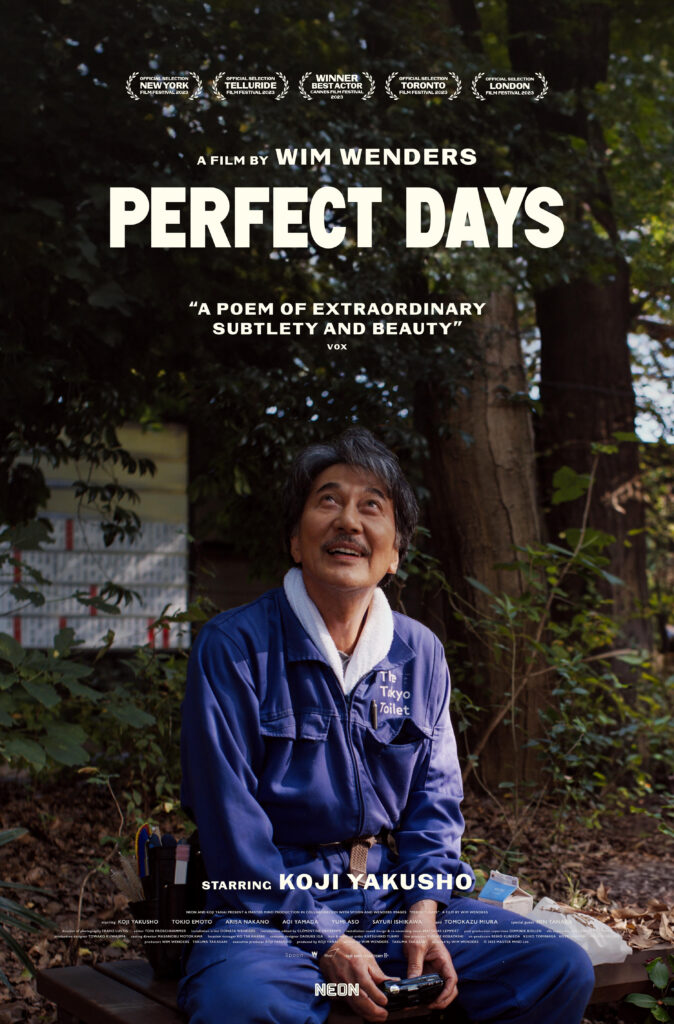
With films directed in at least five different languages, perhaps most notably the Spanish language documentary Buena Vista Social Club; the primarily German language film Wings of Desire; and 2023’s Japanese film Perfect Days, Wim Wenders is no stranger to international work. This has shifted my radar a little bit more in his direction lately as I look for more foreign films as part of my language learning process. But that aside, Perfect Days is a quiet masterpiece that I would recommend to anyone.
Capturing the spirit of zen, Perfect Days is a slice-of-life style film which follows Hirayama, a Tokyo public toilet cleaner who appreciates the everyday, especially music played on cassette tapes, books, and “komorebi” which translates to “sunlight filtering through the trees” and was the original title of the film. Hirayama, played by Kôji Yakusho, lives structured, contented days consisting of waking early in the morning and folding his shikibuton (a foldable futon), doing his job well, photographing komorebi, going to the bathhouse, and appreciating the beauty in things like light and shadows; and much of this with no dialogue on his part, as we don’t even hear him speak until over halfway through the movie. Up to this point, we learn about him solely through his non-verbal interactions like with his assistant Takashi, his mannerisms, reactions, the things he notices, his excellent taste in music, and his love for trees, to which he pays so much attention that he even dreams of komorebi in black and white sequences.
After seeing his silent side, we’re introduced to a bit of dialogue with the people around him, like the restaurant servers at places he frequents, as well as with his family, starting when his niece, Niko, pays him an unexpected visit. I wondered if this would disrupt his tidy routine, but while Hirayama seems slightly apprehensive at first, he is ultimately amenable and enjoys their time together. Niko spends a day with her uncle at work and sneaks a photo of him cleaning the restroom, reads his books, plays one of his cassette tapes on a drive, and enjoys a bike ride with him.
When his sister Keiko comes to pick up her daughter, she and Hirayama have a brief conversation in which Keiko acts reproachful of his job, and then asks if he will visit their father and reveals that there was some kind of troubled past with their dad. It is at this point that you get the feeling that Keiko doesn’t really know or understand him very well, because while on the surface some people might consider the quiet life of a public toilet worker to be sad, Hirayama’s days full of beauty and wonder prove to be the opposite.
As we drift through this halcyon experience with Hirayama, we find that his unique personality elicits different perceptions from different people. As a public sanitation employee, he is invisible to some, and in other situations he evokes fondness and curiosity. Despite anyone’s opinions, though, Hirayama’s positive outlook and love of life are a statement in this film, and one that is well conveyed.