My Neighbor Totoro (1988)
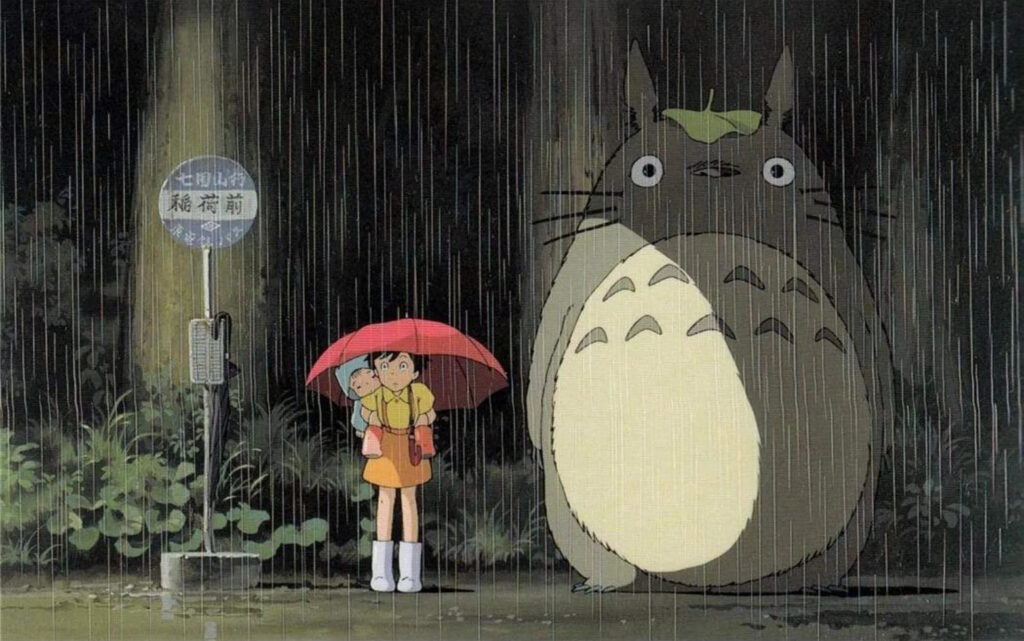
A Japanese movie marathon wouldn’t be right without delving into the wonderful world of Japanese animation, and I’m starting with my favorite out of the few that I’ve seen, the beautifully hand-illustrated film My Neighbor Totoro.
Set in 1950s Japan, My Neighbor Totoro tells the story of a professor, Tatsuo Kusakabe, and his two daughters, Satsuki and Mei, who move to the countryside to be closer to their mother who is in the hospital recovering from a long-term illness. Once they arrive, the children start to explore the old house that they are moving into, and discover that it’s inhabited by dust bunny-like spirits called “susuwatari” or “soot sprites” that can be seen in the shadows and the dark.
At this point I should mention that unlike many stories that involve spirits, none of the spirits in Totoro are frightening, but more like cuddly, lovable creatures. I like how the family doesn’t dismiss their strange sightings, either, and I feel like this is a healthy way to listen to children and a healthy reaction to their experience. Their new neighbor, “Granny,” says that she used to see them as a child, and tells them that “if you keep smiling, they’ll soon leave the house.” The soot sprites do move out, but that’s not the end of the family’s strange encounters. While Mei is playing outside, she finds two more spirits who lead her to a large hollowed tree where she meets an even larger spirit, Totoro.
Mei tries to show Totoro to her family, but they are not able to see him. One day, though, when Mei and Satsuki are waiting for their dad at the bus stop, Totoro appears to both of them. Before boarding his special cat bus that he is waiting for, Totoro gives the children a bundle of seeds in exchange for an umbrella. After they plant the seeds, the children wake up one night to watch the plants grow to be enormous, and the children and spirits have magical garden adventures together.
The sisters find out that they must wait a while to see their mother again, and are disappointed. This leads to an argument between them, but eventually they reunite with their recovering mother once again. If the humans in the story sound very normal to you, you’d be right. Aside from all of the spirits, it’s a very normal story with realistic relationships, but one that is also overflowing with an abundance of joy and a sense of wonder.
My Neighbor Totoro was written and directed by Hayao Miyazaki, who also wrote Spirited Away, Howl’s Moving Castle, Princess Mononoke, and numerous other beloved animations. Miyazaki also designed the primary characters for My Neighbor Totoro and Kazuo Oga designed the watercolor backgrounds for the film, which was made by hand in loving detail by the team at Studio Ghibli. One of the studio’s producers, Toshio Suzuki, described the animation style as “nature painted with translucent colors.”
Totoro is such a big part of Studio Ghibli that he is the mascot and logo for Ghibli (pronounced “Jiburi” (ジブリ) in Japanese). The studio name stems from Miyazaki’s interest in planes and was named for an Italian Saharan scouting plane in the hopes that the studio would “blow a new wind through the anime industry,” and how it did!