Ran (1985)
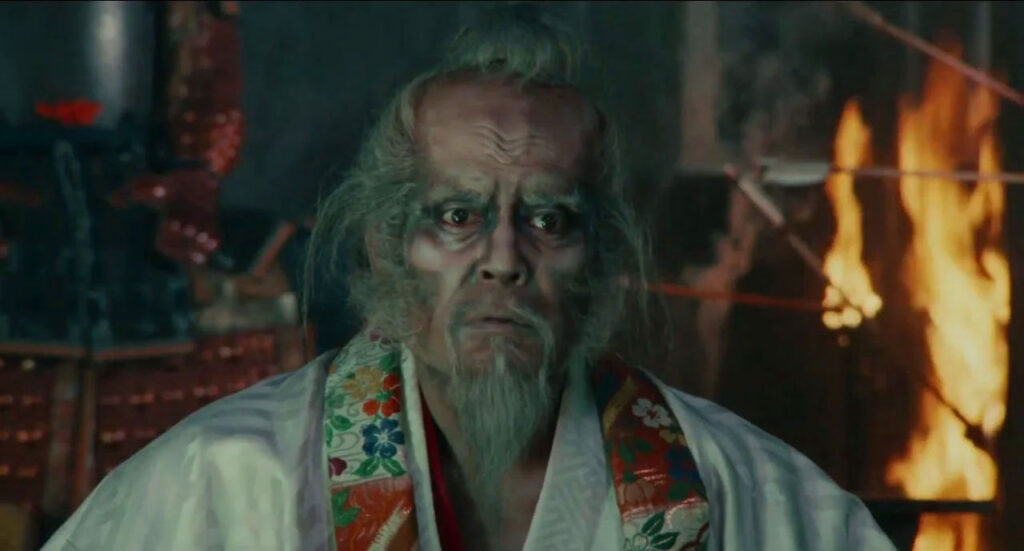
Akira Kurosawa’s Ran (乱, meaning “chaos” in Japanese), an epic film inspired by Shakespeare’s King Lear, tells the story of an elderly warlord, Lord Hidetora Ichimonji (Tatsuya Nakadai), who decides to retire and give his empire to his three sons: the eldest, Taro (Akira Terao), who is to rule, his second son Jiro (Jinpachi Nezu), and his third Saburo (Daisuke Ryu). Hidetora’s announcement of this takes place in the opening scene on a idyllic day in the mountains with his sons, his men, lords from neighboring lands, and the fool. Hidetora envisions that his sons will rule as a strong unit, giving an example of three arrows and how they can easily be broken as a single arrow, but not when they are bound together. However, his youngest son Saburo rebuffs his father’s plan and his arrow parable, pointing out the weaknesses in their family’s relationships: that Taro is only trying to gain favor with flattery, and that “the unity of the three sons is split.” One of Hidetora’s men defends Saburo’s stance, but Saburo is immediately exiled anyway, and we find that only Lord Hidetora’s fool can convey the truth of the matter via his skits. And so the story begins.
This being his last epic film, Kurosawa directed Ran when he was 75 years old, and it is considered one of his greatest. But not only that, it has been on numerous must-watch classic movie lists and is widely regarded by critics and film lovers as one of the greatest films of all time. Akira Kurosawa directed, co-wrote, and edited Ran, which co-stars Mieko Harada as Lady Kaede and Shinnosuke Ikehata as Kyoami the fool, and with sweeping cinematography by Takao Saito, who was nominated for the Academy Award for Best Cinematography, with supporting cinematography by Shoji Ueda and Asakazu Nakai. Ran was also nominated by the Academy for direction by Kurosawa, art direction, and costume design by Emi Wada, which it won.