Tokyo Story (1953)
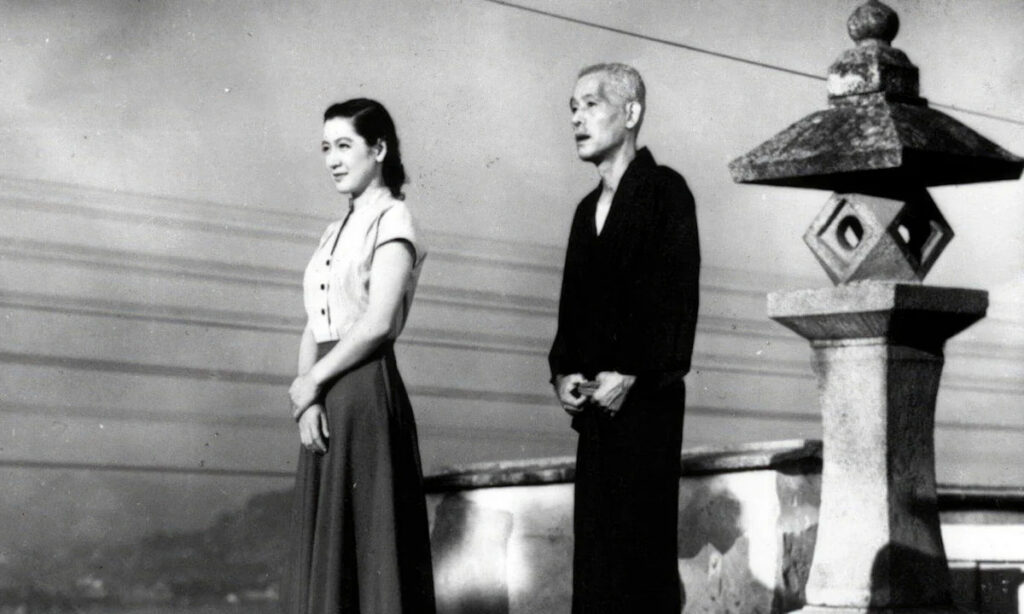
In Tokyo Story, an aging couple take a trip from their city of Onomichi to Tokyo to visit their adult children and grandchildren. The movie opens with scenes of every day life in Onomichi: ships passing, children walking to school, and a train chugging along at the base of the mountains. In the Hirayama house, the aging couple are getting ready for a trip to visit their two oldest children, Kōichi who is a physician, Shige who is a hairdresser, and their widowed daughter-in-law, Noriko, who was married to their middle son, Shōji. Their youngest daughter, a teacher named Kyōko, lives with them and helps them get ready. The opening scenes in Onomichi are the perfect preface to their trip, life goes on and sometimes too quickly, as grandparents Shukichi (Chishū Ryū) and Tomi Hirayama (Chieko Higashiyama) find when they visit Kōichi, Shige, and Noriko, and discover that their oldest children’s busy lives have little room for them.
During their visit everyone is polite, for the most part. The children find activities for the visiting couple and even send them to a spa to “rest.” The grandparents show gratitude during their stay, although they recognize that they are a burden to Kōichi and Shige. Of all of the people they visit, including the grandchildren, their widowed daughter-in-law, Noriko, treats them far better than anyone else. Later in the movie, Shūkichi even admits to Noriko that she treated them better than his own children.
Watching this, I couldn’t help but think of the story of Icarus and the poem Musée des Beaux Arts by W. H. Auden inspired by the painting Landscape with the Fall of Icarus by Pieter Bruegel the Elder. Icarus had made wings out of wax and feathers to escape a tower in which he was imprisoned, but against his father’s warnings, he flew too close to the sun, so the wax melted and Icarus fell into the sea and drowned. This film reminds me of the poem and the painting because both have the noticeable theme that life moves on. In the painting, the world barely notices that Icarus fell from the sky. Here’s a description from the poem:
In Brueghel’s Icarus, for instance: how everything turns away
Quite leisurely from the disaster; the ploughman may
Have heard the splash, the forsaken cry,
But for him it was not an important failure; the sun shone
As it had to on the white legs disappearing into the green
Water; and the expensive delicate ship that must have seen
Something amazing, a boy falling out of the sky,
Had somewhere to get to and sailed calmly on.
A visit from aging parents may not seem as momentous as a boy falling from the sky, but perhaps it should be. And this lesson seems to resonate with the film, because when the aging couple depart from their visit, the mother, Tomi, becomes gravely ill. This highlights the importance of making the most of our time with those who we care about and who care about us while we can.
Tokyo Story was directed by Yasujirō Ozu and is widely considered his greatest work, as well as one of the greatest films of all time. In addition to Tokyo Story, Ozu is well known for Late Spring (1949) and An Autumn Afternoon (1962), all of which are currently available on HBO Max. Chishū Ryū, who played Shukichi, is known for his parts in Ozu’s films and worked on at least 32 of them. Chieko Higashiyama, who played Tomi, was a prolific actor who appeared on over 60 films during her lifetime. The film has received numerous accolades and was even voted the greatest film of all time by a poll of film directors in a 2012 edition of Sight and Sound magazine.